We conclude our month long series on Strait of Hormuz (SoH) Crisis takeaways with a look at what this conflict means for the related topics of sustainability, climate, and the environment.
Three key messages this week:
- Many proponents and opponents of “Net Zero” are drawing the wrong conclusions about what this war means for different energy sources and technologies. Energy’s natural hierarchy of needs applied at the country level mean the optimal mix of various energy sources and technologies will vary for any given country—a reality the crisis reinforces.
- The topic of Sustainability needs to be right-sized and recognized for where it fits into corporate level strategies. Companies exist to generate growth and profitability for investors. Certain sustainability objectives are core to being successful over the long run. Sustainability is not a strategy in and of itself.
- We shall offer free advice on what hyperscalers can learn from the oil & gas industry.
We are going to do our best to not rehash our now well-known pushbacks on the excesses of the 2020-23 “Net Zero” era. The madness of that period we don’t think ever returns, no matter who wins the US presidency in 2028. But we do get the question—and we are appreciative of those of you that ask—how does sustainability, climate, and the environment factor into our outlook for the energy sector, public policy, and corporate strategy and how does the SoH Crisis change or impact the views we have been articulating?
We will start with a grounding on how we think about environmental and climate considerations. Our title gives it away: increasing global prosperity is our centering point, both for countries and companies. In terms of our concern level around the need to address climate change, we would characterize our specific climate opinions as broadly consistent with US Energy Secretary Chris Wright and former University of Colorado professor and Substack author (here) Roger Pielke Jr.
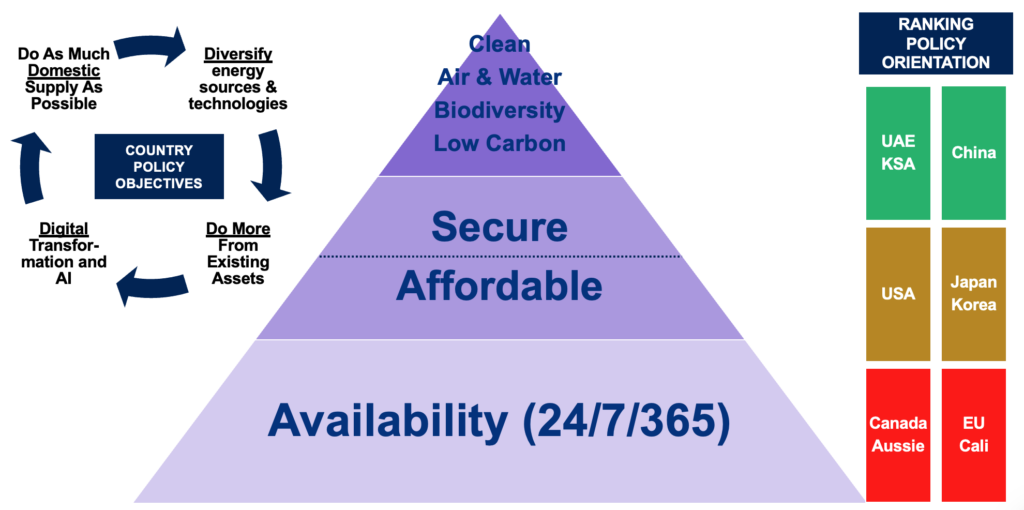
At the country level, energy’s natural hierarchy of needs that we frequently discuss is observably all any country cares about at all times (Exhibit 1). Abundant and reliable energy is a 24/7/365 pre-requisite. It needs to be affordable the vast bulk of the time. Country leaders care about geopolitical security in order to protect reliability and affordability. Clean air and clean water are 100% correlated with societal wealth. Addressing carbon emissions goes hand-in-hand with a maximum prosperity scenario where billion person-scale economies like China and India are highly motivated to crack the code on new energy technologies that are de facto lower in carbon intensity. Pretending that society and companies can be forced onto prescriptive “Paris-aligned Net Zero by 2050 pathways” was the fatal flaw of the 2020-2023 era.
For companies, the only goal is to generate competitive returns and growth for shareholders. Sustainability exists at the level of community engagement, license to operate, and as a possible alternative to government regulation. It is a component of running a company similar to many other functions; it is not a strategy in its own right (e.g., pressuring oil & gas companies to transition business models in the name of addressing climate change never made sense).
With that grounding, we are going to use a Q&A styled format to address how we think the related topics of sustainability, climate, and the environment will be impacted by the Strait of Hormuz Crisis.
Exhibit 1: Energy’s natural hierarchy of needs
Source: Veriten.
Q1: Does the SoH Crisis mean that the core tenet of Net Zero by 2050—which was to switch out of crude oil, natural gas, and coal into renewables, EVs, and other new tech—was correct after all?
No. It does not. Our issue with Net Zero by 2050, or any other year for that matter, is that it incorrectly treats carbon emissions as the organizing principle for economic activity. It is not nor will it ever be, irrespective of how much (or little) concern any specific leader or group of citizens has about climate. There is nothing about the Strait of Hormuz Crisis that suddenly makes Net Zero pathways more relevant.
Q2: So the opponents to Net Zero are correct that renewables and other new technologies are a boondoggle that plays on climate alarmism?
No. It does not mean that either. The focus on non-oil, natural gas, and coal technologies will be driven by the massive unmet energy needs of the other 7 billion people on Earth that seek their own version of the prosperous lifestyles The Lucky 1 Billion of us take for granted. A specific view on climate is largely irrelevant to technology development. Reliability, affordability, and geopolitical security are the motivations to figure out new technologies. We are seeing this in real time in places like China and other Asian countries.
Q3: Are there examples of countries that are adjusting away from a prior emphasis on Net Zero pathways as a result of geopolitical turmoil?
We are optimistic about Norway and Canada, as two countries that are showing signs of appropriate course corrections. In the case of Norway, as a small, wealthy country, de facto mandating 100% EVs in order to not burn gasoline for consumer transportation is a choice they are free to make. More importantly, Norway is remembering that increasing oil and natural gas supply from the Norwegian North Sea is critically important to the geopolitical security and economic health of Norway, Europe, and its allies. Norway is also the home to a vibrant community of new technology companies. More oil, more natural gas, and investing in new technologies—yes!
Canada’s post Trudeau pivot away from Net Zero zealotry seems as much of a reaction to unfavorable rhetoric toward the country from President Trump than necessarily a recognition of how little sense it made for Canada to pursue energy policies that sought to limit the development of its massive oil sands and natural gas resources. Still, we will accept the directional improvement under PM Carney, irrespective of the apparent motivations.
Long-time Super-Spiked subscribers know how critically important we believe energy and power integration between the United States and Canada is, making the recent political schism deeply unfortunate, even as it has seemingly improved energy policy decision making in Canada. The United States is economically and geopolitically stronger thanks to our close energy integration with Canada. The same is true for Canada. We credit our friend, former colleague, and current Deputy Secretary of Commerce Paul Dabbar for the idea that US + Canada + Norway would make for an outstanding trans-Atlantic alliance of energy and technology super powers (here).
Q4: What else does geopolitical turmoil reveal about where the Net Zero mindset went wrong?
The practical application of Net Zero by 2050 policies in many rich-world countries, states, and provinces has been to restrict domestic oil, natural gas, and coal production, mandate the use of new technologies, all while losing competitiveness in manufacturing and business more broadly. Restricting domestic energy supply, making energy prices uncompetitive, and offshoring industrial manufacturing should not be the objective of any country, state, or province. It is without question bad for geopolitical security, bad for domestic economic growth, and bad for the environment.
Rather, we recommend a play on the George Castanza (Seinfeld) line (here): Show me an energy policy strategy that does the opposite. The litmus test is which country’s energy and environmental policies come with competitive energy prices and business and manufacturing growth?
The United Kingdom versus China is case in point. U.K. leaders have spoken glowingly about eliminating coal from their power sector and all but ending viability of the U.K. North Sea for oil and gas exploration. Yet, the country also faces the outsourcing and offshoring of its refining, petrochemical, and broader industrial base. To be clear, the U.K.’s policy challenges are not limited solely to its energy and climate policies, but those are foundational and almost certainly a meaningful contributing factor.
We contrast the U.K. with China which has dramatically increased coal-fired power generation, renewables, nuclear, natural gas, and grown its domestic oil supply while building a massive strategic petroleum reserve. China is now manufacturer to the world with improving living standards for its citizens. The U.K. being on-track, or not, for domestic Net Zero is completely irrelevant to global emissions and, if anything, has been net negative for the climate given China’s higher emissions profile. It has certainly been a negative for the economic competitiveness of the U.K.
Q5: What are the takeaways from the Strait of Hormuz Crisis for corporate sustainability objectives?
Our biggest takeaway is that sustainability is a component of running a successful company, but not a defining objective. It has generally been overstated in importance, especially by a segment of the finance world in Europe and the United States that has pushed for these objectives to gain in prominence. Companies don’t exist for “sustainability.” It never made any sense to pressure oil & gas companies, as an example, to aggressively transition to low-carbon technologies in the name of Net Zero and sustainability. Companies exist to generate competitive profitability and growth for investors. Full stop.
In order to generate long-term profitability and growth, various sustainability objectives (industry and company specific) for sure need to be met. Employee health and safety is at the top of the list along with ensuring the surrounding community to a given asset is also not harmed. Community engagement is core to any company’s license to operate, especially when new growth plans are being pursued. The ultimate list is longer than what is mentioned here, but the point is that this area broadly does not separately merit high profile attention any more than do other critical corporate functions like human resources, legal, cybersecurity, treasury, and so forth. They all contribute to running a successful company.
Q6: What are some contemporary examples of “sustainability” objectives you believe need to be addressed?
Examples of current sustainability issues that we believe should be proactively addressed (not intended to be an exhaustive list):
- Water disposal in the Permian Basin and water usage by AI datacenters are hot button issues that communities understandably want answers to.
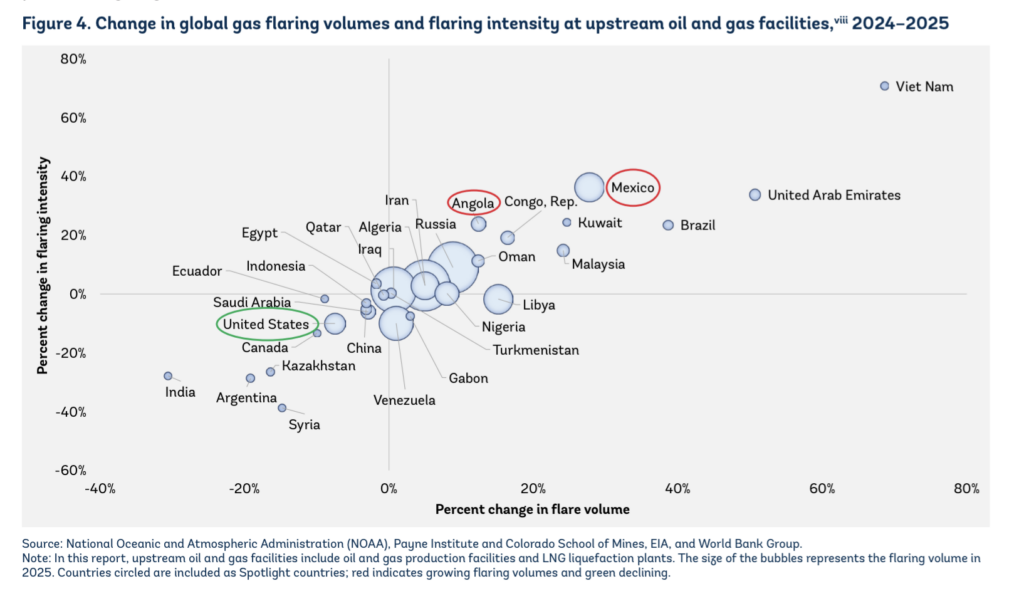
- We have long supported and continue to support near zero methane flaring/venting objectives for the oil & gas industry. This is a topic we have been pleasantly surprised to see the environmental community focus on globally rather than more narrowly just in the United States, Canada, or Europe, as is often the case with activists. We were also pleased to see the progress US companies have made in recent years per the World Bank (Exhibit 2).
Exhibit 2: US producers have reduced flaring intensity
Source: World Bank.
- We believe oil & gas, power sector, and hyperscaler/data center companies all have room for improvement in proactively engaging with the public on their industries, how they contribute to jobs, taxes, and economic development. It is the rare executive that is capable of speaking in normal, human, non-corporate speak language.
In contrast, we do not believe a company’s carbon emissions profile is relevant to its “license to operate” in a given community—a point often pushed by those advocating most loudly for Net Zero policies. No normal human being anywhere spends any time thinking about this. Putting activists aside, no regular person is protesting an oilfield or data center due to its carbon emissions intensity. Water impacts? Yes. Noise? Yes. Particulate pollution? Yes. Traffic? Yes. Carbon emissions? Give me a break.
Q7: What should companies do with previously articulated Net Zero objectives?
Pragmatically speaking, we recognize the significant pressure companies around the world were under during 2020-2023 to articulate company-specific “Net Zero by 2050” objectives. That said, very few if any could possibly have met those goals, since the wider world has never been even remotely on track for Net Zero be it by 2050 or any other year. The Strait of Hormuz Crisis and general geopolitical turmoil is helping more politicians and policy makers recognize that healthy energy policy starts and stops with reliability and affordability. In the interest of being transparent and sincere, companies should be truthful about whether sticking with prior Net Zero aspirations is something they actually think is (1) in the best interest of their companies and (2) is possible on any time horizon that can be modeled today.
Q8: What can hyperscalers learn from the oil & gas industry?
Key lessons:
- You will never appease climate activists. Focus on optimizing for growth and profitability.
- Your prior Net Zero objectives never had a chance of being achieved, especially if including so-called scope 3 emissions. Net Zero does not make sense at the individual company level.
- Economic development, of which the technology sector today is a huge driver, is 100% correlated with clean air and clean water. Richer societies are better equipped than poorer regions to adapt to a broad range of environmental and climate issues. Americans and the wider world is overall better off that our leading technology companies exist in a similar way that we are fortunate to have healthy, vibrant, and profitable energy and power companies.
- Speak sincerely and directly to the general public and the communities where you are investing about the actual impacts of your projects. You can’t outsource this function. It starts with the CEO and then filters down. Skip the corporate speak and language of appeasement.
- Vocally push back on policies that weaken domestic energy development opportunities in any region in which you are investing.
⚡️ On a Personal Note: Gone Shootin’
The last time I shot a gun was in the 4th grade in what was then called Indian Guides. That almost certainly is not the name today; I think in New Jersey it is now called “Adventure Guides” which frankly is kind of lame. I believe we appropriately remembered and honored Native Americans under the original name, but society apparently disagrees with that perspective. Credit to my wife’s brother’s wife, who hails from the Golden State of all places, for the brilliant idea to go clay pigeon shooting during our vacation last week to The Cotswolds, about 2 hours west of London.

Boy was that fun!!! We had a great instructor, Patrick I think was his name—not a fan of London or Londoners apparently; a country guy that was local to the area. There were six in our group. My brother-in-law, his wife and son, and my two daughters. All first timers. All of us successfully hit those crazy clay pigeons popping up in the field. Great job Patrick! Great job in-laws and daughters!
I definitely need to practice. I had some beginners luck on the initial six shells, I want to say with five successful strikes on the ones going straight up in the air. But the ones that were flying away from us gave me more trouble and I was consistently low-left and a bit early. It was oddly tiring. A shot gun is definitely heavier than a golf club. As a second hobby, it’s a keeper. Seems safer than pickleball as a golf complement.