
November 18 marked the five-year anniversary of our launch of Super-Spiked in 2021 as a pushback on the dominant energy transition narratives of that era. There was no part of “The Energy Transition” that we thought made sense. Our disagreement with that world view motivated us to start writing publicly again and eventually led to our un-retirement to Veriten.
We can’t believe we have now been at it for five years! This exceeds the time we spent at Petrie Parkman (3 years), J.P. Morgan Investment Management (4 years), and represents a stunning one-third of the 15 years we were at Goldman Sachs. Time apparently flies when you are having fun.
What motivates us to keep going is the interaction with all of you who read, watch, listen, or otherwise engage with our content. Thank you for always pushing me to be better at energy analysis. We return to Super-Spiked’s roots with a written Q&A-styled post that we will of course also turn into an audio podcast.
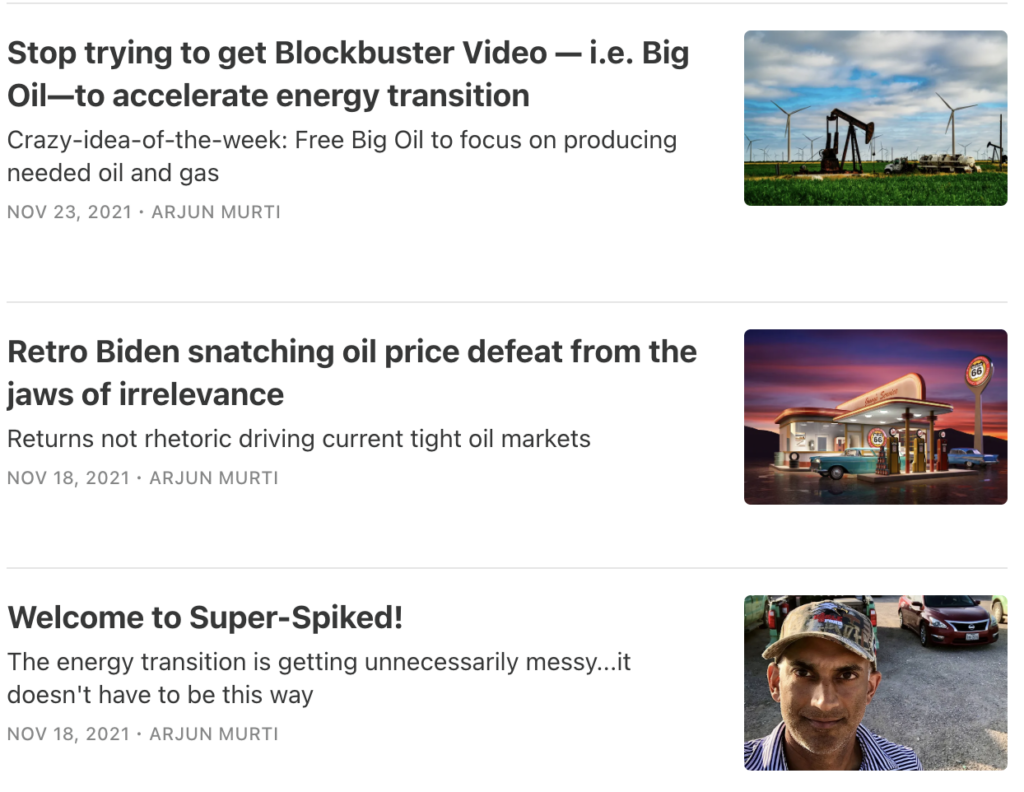
Super-Spiked kicked off on November 18, 2021 with an introductory post and our perspective that returns on capital not anti-oil & gas political rhetoric was driving traditional energy shares; our second post pushed back on the idea that Big Oil should proactively participate in energy transition businesses
Why did we start publishing Super-Spiked?
Super-Spiked was started as a critique of the dominant energy narratives of 2021 that emphasized the need for an urgent transition out of fossil fuels into renewables, EVs, and other new technologies with the goal of net zero carbon emissions by 2050. No part of that narrative made any sense to us. The underlying logic that humanity would be well served by such a transition was flawed and the timing was not even remotely possible. At its core “net zero by 2050” and an “urgent energy transition” are anti-human prosperity and de facto de-growth in their impacts. Goodbye and good riddance.
How it’s going?
With the craziness of the 2020-2023 era firmly in the rearview mirror, Super-Spiked has transitioned to a general commentary on (1) the energy macro outlook including for traditional oil & gas value chains, power, and new energy technologies; (2) what we think makes sense from a corporate strategy standpoint for companies involved in the energy sector broadly speaking; and (3) what we think constitutes sensible energy policy from governments around the world. Even as some people we interact with have reasonably held beliefs about the importance of doing more to address carbon emissions, we see little chance of the world returning to the kind of nonsensical policies and narratives that dominated 2020-2023. That will certainly not be happening in the Geopolitical Super Vol era the world has entered.
What are our five favorite Super-Spiked themes?
The five Super-Spiked themes we like best are:
- The Lucky 1 Billion versus the other 7 billion
- Everyone on Earth deserves to be energy rich
- Energy’s natural hierarchy of needs
- Obliterating peak oil demand
- Super vol versus super-cycle mindset
These themes represent our foundational views from which all other content derives. For some reason we do not have this last one as a branded theme but an additional core principle of ours is the idea that energy and power companies should pursue strategies that lead to advantaged full cycle profitability and per share growth. This is the only reason companies exist in the first place, a point that many attempted to push aside in 2020-2023 via what we will call extreme applications of ESG strategies.
How has our approach to publishing Super-Spiked evolved?
Super-Spiked started off as primarily a written product with occasional video podcasts to now being almost exclusively a podcast with only occasional written posts. For our five year anniversary, we have chosen to write. If forced to choose between writing every week or podcasting, writing would win hands down. That said, the ratio of subscribers that say they prefer listening to a podcast versus reading a post (or transcript) is at least 9:1. Moreover, as Veriten’s business has ramped, the time we have to write a dedicated Super-Spiked post each week has dwindled.
With all that said, writing forces a discipline to the expression of one’s views that we do not think can be replicated via “talking.” Writing forces a “do I really believe this and does it make sense in black and white” realization that we do not find exists when talking. We likely need to find the moments to write more than we have been doing of late.
Should we reduce the frequency of Super-Spiked to be every other week or even monthly?
No. There is no reason for us to suddenly become lazy, especially given how dynamic of an environment it is in the broad energy and power space.
What garners the most comments?
The On A Personal Note section by far—and it’s not a close call—garners the vast bulk of subscriber comments. We always say we want to hear from people that either disagree with us or otherwise have alternative viewpoints. Compliments are always welcomed!
How could we change Super-Spiked to significantly spike subscriber counts?
If we adopted a more strongly partisan view or transitioned to providing explicit investment recommendations, we could undoubtedly significantly grow our subscriber numbers. We abhor partisan politics so will not be doing the former. As for the latter, we leave that to the Wall Street pros; we have no desire to recreate our old Goldman Sachs analyst role. We appreciate the high quality nature of our current subscriber base in terms of corporate executives, board members, policy makers, and institutional investors. We do hope Super-Spiked is accessible to a much broader audience of people interested or otherwise involved in the global energy sector.
Who is our target audience?
Primarily energy and power executives and board members. We enjoy running into our former institutional investor clients but do not miss having to engage with that audience as our primary objective. We really enjoy our work at Veriten helping executive leadership teams and board directors think through corporate strategy and the energy macro.
What one change would we like to see with U.S. energy policy?
In the U.S. in particular, there is still too much “left/right” distinction on preferred energy sources. It is really bizarre that fossil fuels are viewed as being a Republican energy source and renewables as for Democrats. That mindset leads to some really unfortunate policy gridlock in our country. Being against natural gas and related infrastructure is Un-American. Being against some new technologies and methane abatement is ignorant. Both sides s–k.
What one change would we like to see among energy companies, investors, and energy experts?
It’s a corollary sentiment to the prior point about energy policy and that is we reject the idea that energy sources are inherently in conflict with one another such that if one technology gains another one automatically loses. It is that kind of zero sum mindset that fueled preposterous net zero scenarios and incorrect “peak demand” narratives. Rather, using one form of energy is often positive for a different form, driven by virtuous economic expansion. In a world where a staggering 7 billion or so people are still looking to move up and to the right on prosperity metrics, the idea that any individual form of energy should face derision or phase-out is nonsensical.
⚡️ On a Personal Note: A career path leading to Super-Spiked
The career path that led to the creation of Super-Spiked was not obvious at any point of my journey.
1992: University of Denver professor Dr. Ron Rizzuto recommends me to Petrie Parkman, where I join as a junior equity research analyst. 34 years later I still identify as an equity research analyst first and foremost!
1995: Chris Corapi recruits me to J.P. Morgan Investment Management, where I was a buy-side energy equity analyst.
1999: Don Textor recruits me to Goldman Sachs to lead sell-side equity research coverage of the integrated oils and refining sector.
2014: My wife convinces me to retire from Goldman Sachs given that I was clearly not loving the Director of Research role I had been in for the prior the years. This was easily one of the best decisions I’ve ever made as I was able to be home for all three of our kids during their middle and high school years. No amount of missed Goldman partner compensation could make up for those years.
2015: I joined Warburg Pincus as a senior advisor and ConocoPhillips as an independent member of their board of directors, helping create a perfect balance between staying plugged in post-Goldman retirement and beginning to ramp up my golf game. In subsequent years I also become an advisory board member at the Center on Global Energy Policy at Columbia University and at ClearPath. In 2025, I joined the board of Liberty Energy when its long-time CEO Chris Wright was named Secretary of Energy. The combination of private equity, public policy, and public company board experience has really helped round out my understanding of corporate strategy and the energy macro, which I utilize daily at Veriten.
2020: The COVID-driven collapse in oil prices motivated me to return to publicly engaging on the energy outlook via Twitter. This was a surprisingly fun experience, though the nature of Twitter did not lend itself to longer form content.
2021: While checking out Substack, a new publishing platform, I linked my Twitter profile to a draft Super-Spiked page I was playing around with. Seventeen people immediately signed up, which I found shocking and convinced me to publish my first post on November 18, 2021.
2023: Eighteen months of publishing Super-Spiked and the start of a major new energy cycle motivated me to join a former Goldman Sachs friend Maynard Holt at his new venture, Veriten. Veriten’s mission of “Truth in Energy” matched my approach to Super-Spiked. I had noticed that I no longer wanted to remain solely on the “back lines” as a senior advisor or board member, but wanted to help companies proactively think about corporate strategy in order to drive long-term share price outperformance. Hence, I “un-retired” to full-time employment at Veriten. Veriten in many respects feels like coming full circle to my start at Petrie Parkman, which was in its third year of existence when I joined in 1992.
Future: How much longer will we keep publishing Super-Spiked? Who knows. In the near term, I we will take Thanksgiving weekend off and return the first week of December. I am really excited about all the progress that all of us at Veriten have made in progressing the firm’s business model. If I can make one prediction about my future, I won’t return to using the word “retired” ever again. It is Veriten for the foreseeable future and a likely portfolio of projects over my remaining life span.